Fade in:
INT. A director's study. Day.
Alfred Hitchcock sits at a desk, writing down how he makes a film. Most of the work, he explains, happens before anyone picks up a camera.
I like to have a film complete in my mind before I go on the floor.
He means the script, worked so closely that the shoot only carries out decisions already made.
When I’ve done it, the film is finished already in my mind.
Insert. A storyboard for Vertigo.
Rows of ink sketches for the Fort Point scene in Vertigo, each with a typed caption pasted below. One reads: "Sc. 136 LOC. Scottie's viewpoint – Madeleine standing at water's edge – tearing off paper from nosegay." Every caption says where we are, whose eyes we're looking through, and what happens.
INT. A film set. A laptop on a table.
Wes Anderson goes a step further. Before shooting, he makes an animated version of the whole film and voices every character himself. The cast gathers around the laptop to watch it.
Wes makes an animatic and voices all the characters in the animatic, what he calls the cartoon.
Oh, got it. I see where you’re going.
Neither director used the board as decoration. They used it to decide.
INT. Your team. Now.
Agents have flipped the cost of building. An agent writes a feature in an afternoon, so building is the shooting now: the cheap, fast part that carries out decisions. If you design an agent product by building it, you're shooting without a board. You get footage, and then you find out what the film was about.
This is the eighth part of the series. The earlier parts each took one idea: the four goals, situations, turns worth taking, the wait, reports as stories, designing backwards, and what the work leaves. This one puts them all on one sheet of paper.
A wireframe would be the wrong sheet. It shows one screen, at one moment, for one person. Agent products don't live on one screen. A run starts Monday at an engineer's desk and blocks on Tuesday in the middle of a meeting. It lands Wednesday as a pull request, and turns into a decision on Thursday in an executive's inbox. Most of the people who see a slice of it never talk to each other about it. A storyboard was made for exactly that: cuts, who's in frame, what each person wants, and what happens next.
The method takes six moves. The running example is an agent that moves sixty-one services to a new auth client before a security deadline.
INT. A bare table. Nothing drawn yet.
First, scatter the primitives. List every primitive the product has and lay them out like cards. There are four kinds:
- Things: a goal, a check, a receipt, a trail.
- Moves: a run, an answer.
- Signals: what the system says about itself without being asked, such as a status or a board.
- Gates: where a person has to decide, such as a question or a decision card.
Don't arrange the cards into screens yet. Screens come last, if they come at all.
Who would reach for this card, and when?
A card nobody reaches for is a cost with no story. I did this for a terminal in Rex, one primitive at a time. The primitives were good. What made them matter was who picked them up.
INT. A casting room.
Second, cast the characters, and ask what each one wants. Agent products built for teams usually have the same cast of four: the engineer who works with the agent, the leader who answers for the team, the executive who answers for the outcome, and the agent itself.
Ask each of them what they want, using the four goals: to win, to get it right, to keep it interesting, and to account for everything. Then ask two more questions. What are you afraid of finding out too late? What would let you stop checking?
This is where Anderson's habit earns its keep. Don't describe the characters from the outside ("users want visibility"). Voice them, and make each one finish the same sentence.

I stop checking when the check is green and the receipt lists every skip.

I stop when the board shows only exceptions, and there are none.

I stop checking when one line a week either says we’re on track or names the one decision that’s mine.
I don’t check. I stop when the check passes, or when a person has to decide.
The agent has no fears. It has a stopping rule. A want only counts if you can say who wants it, when, and what they'd do next.
INT. Monday to Thursday. A run of situations.
Third, put them in situations. A situation is a moment that holds a choice, as in part two. Give each one a time, what's on the table, and the choice. Monday morning, the engineer hands the agent a goal and a check in the same box, so the agent knows what done looks like.
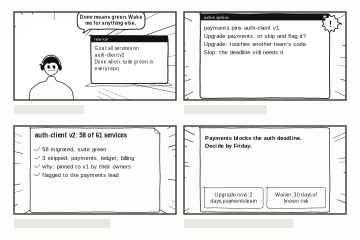
Done means green. Wake me for anything else.
Then ask whether the person would make the same choice every time. If they would, it isn't a choice. It's a toll, and it belongs off the board.
The long run comes next. The engineer works on something else, and glances over now and then. That glance is the wait, and it should tell them whether to keep working or step in. Most of the time it should say: keep working.
On Tuesday the agent reaches a service another team owns. It doesn't guess. It stops and puts one question in the tab, with the options and what each one costs.
This service belongs to Payments. Upgrade it now, or skip it and flag it?
The engineer is in a meeting. The question has to be answerable from a phone, in one tap, without opening a laptop.
Skip it. Flag it for the lead.
EXT. Grand Central Terminal. Noon.
Fourth, find where they meet without talking. Thomas Schelling once asked students where they would meet a stranger in New York if neither could contact the other. The most common answer was noon at the information booth in Grand Central. Nothing made that spot better than any other. It was simply the place everyone would think of. These became known as focal points, or Schelling points.
Teams that work with agents are full of people who don't talk in real time. The engineer and the executive may never speak about this migration at all. Each pair still needs a place both of them will look. Design the meeting there.
Usually the place already exists. Leads already start the week at a board, so the skipped service shows up there on Monday as the one card that needs a person.
Engineers and leads already meet at the pull request. Use places like these before you invent anything new. Then ask what must be visible there for each person to trust it without asking the other. At the pull request, the engineer wants every skip, the lead wants proof that no team was surprised, and the agent wants to leave a receipt someone will trust. It's one place serving three wants. A meeting point is where value changes hands.
When I ran a checker over the first draft of this board, it asked me a question.
If Engineer and Executive never talk, where would both look to learn how the work is going?
I had no answer. The engineer's detail and the executive's decision lived in different places. The answer became the last beat: a trail that links the decision, the diff, and the reasons.
INT. The cutting room.
Fifth, board the beats. Each beat is a panel: a shot, who's in frame, the primitive in play, what each character wants right now, the line, and what's on the screen. Under each panel go three notes: what the beat asks of the design, what could go wrong, and what it decided.
Shot size works like altitude. A wide shot is the leader's view: where everything is, and who's stuck. A close-up is the engineer's view: this diff, this question. An insert, where one object fills the frame, is the executive's view: the card, the number. An over-the-shoulder shot is the wait, someone watching the agent work.
When you catch yourself drawing an executive in a close-up, ask whether they need the close work, or one thing they can act on. The Payments question reaches the executive on Thursday as an insert: one card, two options, what each costs, and a date.
Upgrade now. Payments goes first next sprint.
The decision doesn't end the story. It becomes a new goal for an agent, and the board starts again. You can open the whole board, with the reasoning under every panel and a button to watch it through each character's eyes.
INT. A screening room.
Sixth, read it back from every seat. Read the board as one character at a time. The engineer's story should have a start, a block they can clear from a phone, and an end they can walk away from. The leader should hear about trouble before anyone tells them. The executive should get one decision, with a date on it. Wherever a character's story stalls, the design stalls with it.
Then look at what the board decided. Here are four of its nine decisions:
- Every run starts with a goal and a check, written in the same box.
- A blocked status carries the question, the options, and what each option costs.
- Skips come before successes, each with its reason.
- Escalations arrive as one choice, with costs and a date.
None of these is a screen. Each one decides who sees what, when, and why. The screens come after, and they're easy to build once the film is finished.
INT. Your terminal.
I turned the method into a skill and an MCP server called storyboard. It runs the six moves as a conversation, one question at a time, and it doesn't answer for you.
Who is this for? Name one person, and what they were doing when the agent stopped.
Engineers.
Which engineer, though? Answer as them: what would let you stop checking?
It keeps the board as a file and checks it for gaps: a character who never appears, a gate nobody answers, two people with no place to meet. Each gap becomes its next question. Before it leans on a principle, it reads the essay in this series that the principle comes from. At the end it draws the board, as a page you can watch through each character's eyes.
Hitchcock finished the film before he went on the floor. With agents, the floor is cheap. Finish the film first.
Fade out.
(Now you just read a script without realizing it.)