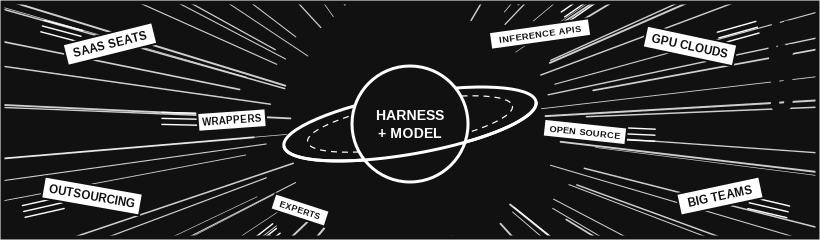
A harness is the loop around a model. It reads files, runs commands, calls tools, checks its own work and tries again. Claude Code, Codex and OpenCode are harnesses. Put a strong model inside a good harness and you get something that does the work instead of answering questions about it.
In 2026 that pairing started to behave like a black hole. It has mass, and mass pulls. Anthropic's IPO filing shows $4.6 billion of revenue for all of 2025 and $17.0 billion in the third quarter of 2026 alone. With that much pull, a single blog post moves markets. On February 3, a legal plugin for Claude Cowork knocked as much as 18% off Thomson Reuters in a day. RELX had its worst day since 1988 (Legal.io). On February 23, a post about modernizing COBOL took 13% off IBM (CNBC).
Whatever sits closest to a black hole falls in first. Things further out orbit for a while, and a few get slung outward faster than they arrived. Below is my map for 2027 of who falls in, who orbits and who gets slung out. Each prediction comes with the evidence I'd stake it on and the signal that would prove me wrong. I'll score them in a year.
1. Legacy software erodes at the seat, not the revenue line
Seat-priced software is losing its reason to exist faster than it is losing revenue. A seat assumes one person per login. When an agent does the work, a company needs fewer logins.
The market priced this in early. By April, Atlassian was down 58% for the year, and Bank of America cut its target, saying "the link between headcount growth and software revenue is weakening" (Finexus). By June, HubSpot was down 46% and Monday.com 45%, while usage-priced DigitalOcean was up 220% and Datadog 76% (The Next Web).
Revenue hasn't fallen, though. Salesforce grew 11% last quarter and Workday 12.8% (SiliconANGLE). Inside Salesforce, the seat-heavy apps grew 8% while the data layer that agents call grew 20% (Salesforce). The company doing the pulling is metered: 79% of Anthropic's revenue this year came from tokens, not subscriptions (The AI Insider).
Prediction: no major SaaS vendor reports a yearly drop in subscription revenue in 2027, but at least three move from seats toward credits or usage. Wrong if a big vendor posts a subscription decline tied to lost seats, or seat products start growing faster than platform products.
2. Peripheral AI services die or get bought
When a product is one feature of the assistant, it becomes a checkbox in the assistant's next release. Relay, a workflow-automation startup, shut down in August. TechCrunch's running list of AI shutdowns says it lost "its reason to exist" once OpenAI and Google built the same thing in. Notion Mail closed because its users were running their own agents to manage email.
The big independents get pulled in too. In a year, Cursor's share of spending on coding tools fell from 41% to about 26%, while Anthropic took about half the category. Then Cursor sold to SpaceX for $60 billion (CNBC). The usual exit now is license-and-hire: the buyer licenses the technology, hires the founders and leaves a shell behind. Windsurf went that way, and so did Groq, for a reported $20 billion (CNBC). Character.AI, the shell left over from an earlier deal, filed for bankruptcy in October.
Getting pulled in isn't certain, though. OpenAI shut down its own Sora app, its Atlas browser and Operator this year. The labs fold features into the main assistant, and they don't win every category they enter.
Prediction: single-feature AI apps keep shutting down after lab launches, and independent coding and agent apps leave by acquisition rather than IPO. Wrong if independent coding tools win back share of spending from Anthropic and OpenAI in 2027.
3. Outsourcing doesn't die in 2027, but its billing model does
I'd like to tell you Wipro, Infosys and TCS will be dead by 2027. The evidence points to something slower: they stop growing, and the way they charge for work stops making sense.
TCS posted what the press called its first annual revenue decline, down 2.4% in constant currency for the year to March, and cut 23,460 people. Wipro shrank 1.6% (The Signal). Infosys cut its growth guidance to 1–2% in October, in the same quarter it signed $5.2 billion of large deals (Infosys). In October the industry started saying it out loud.

We are in the early phases of deflation.
We are definitely giving more productivity due to AI.
ISG's data show contract value for application development and maintenance, the heart of the Indian model, down 8% on a year ago (ISG). Kotak expects revenue to deflate 3–3.5% a year through fiscal 2028, with no growth above 5% before 2029 (ANI). Clients are also bringing work in-house. In the first eight months of 2026, 111 new in-house tech centres opened in India, more than in all of 2025 (BW People).
These firms aren't collapsing. Margins held at 24% for TCS and 21% for Infosys, Accenture grew 5%, and modernizing old systems is real work. But you can't keep charging per head once a tool removes heads. When the agent writes the code, the per-person rate card is what dies.
Prediction: TCS, Infosys and Wipro grow 0–4% through 2027, and AI deflation of 2–3.5% a year becomes an explicit term in contracts. Wrong if any of the three guides to 5% or more organic growth for fiscal 2028.
4. Teams shrink, and the middle goes first
Every engineer and every manager now gets measured against a subscription. Claude's top plan, ChatGPT Pro and Cursor Ultra each cost $200 a month (Claude pricing). That's about 1.8% of a median US developer's base pay of $134,040 (BLS). Nobody replaces a good engineer with $200. But the comparison now sits in every finance team's spreadsheet, and anyone whose output is coordination rather than judgment looks bad on it.
Big teams were already slow. Fred Brooks said so in 1975, and the data keeps agreeing with him. Across 201 GitHub projects, output per person peaked at a team of one (Gote et al.). Across 65 million papers, patents and software products, small teams disrupt while large teams develop what already exists (Wu, Wang and Evans). On a big team, everyone wants to build their own thing, and people differ in how well they can steer an agent. Agents widen that gap. In Anthropic's study of about 400,000 uses of Claude Code, novices succeeded 15% of the time, against 28–33% for everyone else (Anthropic).
The cuts are landing where you'd expect. Google has 35% fewer managers of small teams (NBC). Microsoft is "reducing layers with fewer managers" (The Register). Meta cut about 8,000 people in May, and the cuts fell hardest on managers (Fortune). At Anthropic, juniors fell from 27% of technical hires to 9% (Anthropic). Lovable reached $400 million in annual revenue with 146 people (TechCrunch).
The limit is review, not typing. Teams that use AI heavily merge 98% more pull requests, spend 91% longer reviewing them, and show no gain in company-wide delivery (Faros). METR's careful trials went from a 19% slowdown in 2025 to 2026 speedups it can't yet tell apart from zero (METR). And software job postings are up 21% on a year ago, though still 22% below February 2020 (The Uptime Report).
Prediction: teams shrink at the junior end and in the management layers while total demand holds, and reviewing becomes the job. Wrong if a rigorous 2027 study shows experienced developers shipping real features twice as fast, or postings fall to a new low.
5. Everyone's an expert, and they all sound the same
Making content is now nearly free, so supply has exploded. On one day in April, 45.7% of new podcasts in the Podcast Index looked AI-made, and a single company published 325 shows that day (Podnews). On Deezer, fully AI-made tracks passed half of daily uploads in July (Deezer). About half of new web articles are written by AI (Graphite).
The same engines, prompts and skills produce the same ideas. This is the most consistently replicated finding in the research: AI help makes each person's work rate better and makes everyone's work more alike. Writers given AI story ideas wrote better stories that resembled each other (Doshi and Hauser). Polishing with an LLM cut the variety in writing style by 21–50% across 880,000 texts (Sourati et al.).
Audiences notice. AI tracks are over half of Deezer's uploads but only 1–3% of its streams. Human writers still produce 86% of the articles that rank in Google (Axios). Only 12% of people are comfortable with news made entirely by AI, a share that hasn't moved since 2024 (Reuters Institute).
Prediction: AI wins uploads but not attention. What becomes scarce is your own source material and your own taste, which no engine can supply. Wrong if fully AI-made tracks pass 10% of streams on Deezer or Spotify.
6. GPU landlords break before inference does
Demand for inference is enormous, and the problem is debt. CoreWeave's revenue rose 168% to $3.66 billion in the third quarter. It still lost $709 million, its interest bill was 2.2 times its adjusted operating income, and it has $10.97 billion of debt coming due in 2027 (sec-api). Its bonds yield about 15.7% (CNBC) and its stock is down about 77% from its high (Motley Fool).
GPU rental prices didn't crash. They rose about 40% from their October 2025 low as capacity sold out (SemiAnalysis). What crashed was the price of a token. On OpenRouter this year, the number of tokens is up 44 times while spending is up only 7.6 times. The average price per token fell 83%, and spending has been flat since October (OpenRouter). The same open model costs the same on Groq, Together and Fireworks. When three hosts charge the same price for the same weights, none of them can raise it.
Access to capital for a large number of neoclouds is going to disappear.
There is a real case on the other side. Cerebras had the biggest IPO of the year when it listed in May (TechCrunch), and Fireworks passed $1 billion in annualized revenue (CNBC). The survivors own their chips, sell speed, or sit on top of everyone else as routers.
Prediction: at least one GPU cloud defaults, restructures or sells under pressure in 2027, while CoreWeave itself survives. Inference hosts keep growing tokens faster than revenue. Wrong if no GPU cloud restructures by the end of 2027 and OpenRouter spending grows again by more than 10% a month.
7. The plumbing is where the money is, until it gets eaten
This is where I'd build. Anyone working through a harness needs pipes: a safe place to run code, a way to reach their own machines, compute that spills from the laptop to the cloud when a job gets big, and a way to watch many agents at once. In everything I looked at, those pipes are growing fastest.
- Sandboxes. Modal passed $300 million in annualized revenue, and its sandbox product roughly doubled every month for six months (TBPN). Cloudflare started 100,000 containers in 5.4 seconds (Cloudflare). Unikraft raised money to run the same jobs on unikernels (FinSMEs).
- Networks. Tailscale doubled its paid business customers to nearly 40,000 in eight months, and agents now recommend, buy and deploy it on their own (BetaKit).
- Local compute. Ollama serves 8.9 million developers a month with 14 employees. Its cloud tier runs models too big for your laptop, so work spills from local to cloud (TechCrunch).
- Harnesses. OpenCode went from 650,000 to 13 million monthly users in six months (Root Access). The argument between thin harnesses like pi, which has four tools and a short prompt, and thick ones is still open, and no benchmark settles it.
- Multiplexers. tmux and Zellij show you text, not what each agent is doing. A layer that shows agent state is just starting; I wrote about one, Rex.
Then the pull begins. Anthropic bought Bun, the JavaScript runtime under Claude Code, in December 2025 (Anthropic), and Stainless, which generates its SDKs, in May (Anthropic). OpenAI bought Astral, the makers of uv and Ruff (Techzine). From the time a category got popular to the time a lab bought into it took anywhere from five months for Sky (OpenAI) to four years for Bun. The labs buy whatever sits on their agent's critical path.
So the play is to build the pipe, earn momentum and market share, and go in knowing the ending: eventually the frontier lab wants it.
Prediction: the plumbing compounds fast and gets bought. Anthropic and OpenAI together announce at least five acquisitions of developer tools or agent infrastructure in 2027. Sandboxes stay independent a while longer, because the labs chose to partner there instead (Claude). Wrong if fewer than three such deals happen in 2027.
8. Open source isn't dead, but open contribution is
On the numbers, open source has never been busier. GitHub counted 2.5 billion public contributions this year, more than double last year, and by September agents were opening over 40% of pull requests (GitHub). The activity now comes from agents.
What's breaking is the community around the code. In a Linux Foundation survey, maintainers judged about a quarter of incoming pull requests to be "AI slop" (Linux Foundation). GitHub now lets maintainers switch pull requests off (GitHub). Ghostty accepts AI-assisted changes only for approved issues, Godot banned AI agents, and Jazzband shut down (Open {re}Source). Stack Overflow got 1,072 questions in June, against 200,000 a month at its peak (36Kr). More people than ever use Tailwind, yet its revenue fell about 80% and it laid off three of its four engineers (DevClass).
And people are building their own versions. One person had AI convert curl to Rust for about $8,600. Daniel Stenberg, who maintains curl, points out that the real project merged 300 commits in those same three weeks. Curl's value is the iteration, the tests and the community, not the code.
Prediction: open-source activity sets new records while contribution narrows to people the maintainers invite in. Projects that earned money from human visitors keep losing it. Wrong if major projects reopen to drive-by pull requests because AI triage solved review.
Who survives
Nearest the black hole are the harness and the model. Falling in are single-feature apps, per-head billing, seat pricing, GPU landlords living on debt, and open source funded by attention. In orbit are the big SaaS and services firms, still growing and slowly repricing. Slung outward are small teams that steer well and creators with something of their own to say. So are the people building the plumbing, for as long as they stay ahead of the pull.
I'll come back in December 2027 and score every one of these.